Candle in the Darkness
- Rivett '25
- Nov 4, 2025
- 5 min read

Samantha Syral P, III BA English
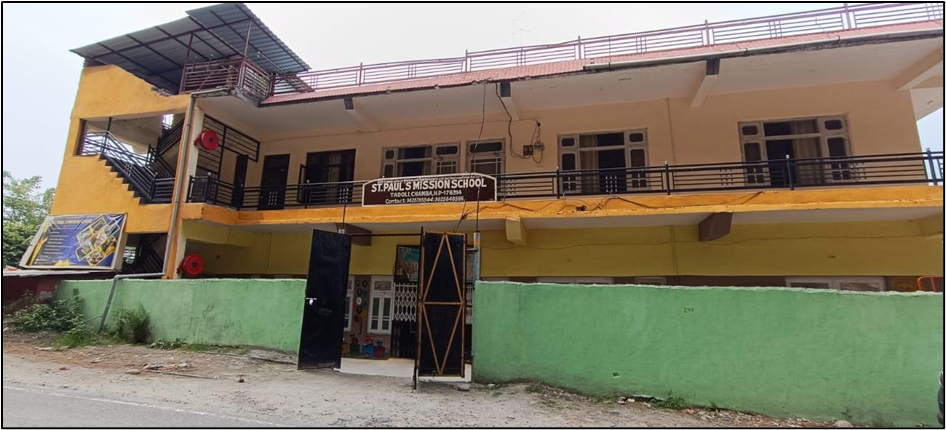
During a regular Sunday sermon at my church, an unexpected opportunity presented itself. A pastor, who also served as the Principal of St. Paul’s Mission School in Chamba, Himachal Pradesh, was invited to deliver the sermon. While speaking, he mentioned that the school was in need of teachers, particularly English instructors. After the service, I approached him

and offered to help once I completed my degree. At that time, it felt like a casual conversation, but events unfolded more quickly than I anticipated. When I shared our conversation with my mother, she immediately saw its potential and suggested that I consider doing my summer internship there. We had already been searching for a safe and secure place for my internship, and this seemed like the perfect fit. About three weeks later, I began my journey to Himachal Pradesh. I remember the day of my departure vividly. Each moment felt unfamiliar yet filled with anticipation. Though I was excited, I also felt quite nervous. The idea of adapting to a completely new environment for over a month was slightly overwhelming. More than anything, I felt uneasy about being away from my mother. I had never spent more than a couple of days apart from her, and this felt like a major leap, both exciting and uncertain.

Himachal Pradesh, in northern India, shares borders with Jammu and Kashmir, Punjab, Chandigarh, and China. It is a hilly region in the Greater Himalayas, with altitudes from 350 to 6,975 meters. The people here reflect diverse cultures and beliefs, with over 35 languages spoken; Hindi is the official language. Chamba is one of the backward districts of Himachal Pradesh and home to three major tribal communities: the Gaddis, Pangwalis, and Gujjars. It has a rich history and tradition, with six languages spoken—Burmori/Gaddi, Pangwali, Churahi, Chambiali, and Gujri. Most people here are farmers. Villages are electrified, road-connected, and tourism is a key source of income. River Ravi flows through Chamba. People here love dancing at every gathering. St. Paul’s Mission School, the school where I volunteered to complete my internship, was founded to enlighten society through education, guided by the motto “Lightened to Light.” Despite its modest beginnings, the organization’s vision is wide-reaching, aiming to spread knowledge and dispel ignorance. Many villages remain in spiritual darkness, bound by beliefs in black magic, depending on sorcerers, and lacking basic medical and educational facilities. I felt an instant connection with the school, especially because its motto mirrors that of my college, “Lighted to lighten”.

I’d like to share a few experiences from this special internship that will forever remain etched in my memory. My biggest challenge was isolation. Back home, my mom is my best friend - I share almost everything with her. But there, I was asked not to share too much information with her so she wouldn’t worry. This left me with no one to open up to. I was staying with a local family, but because of the language barrier, I couldn’t talk much to them. For someone like me who’s always talking, the silence was hard to handle. My next concern was the food. Their meals were mostly chappatis, rice, and sabzi made of lentils.This they had even three times a day. That’s when I realized how much I missed dosa, idli and vada! Eventually, I started cooking for myself - I mean, I had to, when I couldn’t take another day of their never-ending lentil dishes!
One of the many incidents that I’ll never forget is the terrorist attack that occurred the very day I arrived in Chamba. The Principal of the school, who was my supervisor as well, had left for Chennai, on some emergency, leaving me completely alone. Coincidentally, the day he landed in Chennai, Pakistan bombed three locations in India, one of which was Pathankot, which was just four hours from where I was staying! Unaware of this, I was fast asleep until my Uncle called and said urgently, “Get up, charge your phone, fill the buckets, Pakistan has dropped a bomb in Pathankot. They've cut the power there and it may go out at Chamba too.” He hung up immediately. I did not get hold of the tension at that time, but only when my phone was flooded with calls from my worried family did its gravity hit me and I broke down. I cried my heart out to my Maama (mother's brother) but kept strong for my mom. Sleep didn’t come easily. I stayed up, praying and reading my Bible, finally dozing off past 2:30 a.m.
Another unforgettable moment came one night around 12:30 a.m., when my Maama suddenly called to check on me. The call was brief, but a few days later, he asked, “Have I ever called you that late before? Do you know why I did?” Curious, I said no. He replied, “That night, I came home, turned on the news, and saw a breaking report - there had just been a mild earthquake in Chamba.” I was stunned. I hadn’t even felt it. The thought that he knew before I did still gives me chills. This experience too is etched in my memory forever.
My time at the school with those wonderful children taught me valuable lessons and revealed hidden talents I didn’t know I had. This internship helped me connect deeply with the school’s greater vision. The final day was especially emotional - reading letters from the children about my impact moved me. I realised the value of my service and the change I could bring. The farewell session, with teachers and children in tears, left me speechless. I couldn’t hold back my own tears and felt a strong urge to return there to work someday. My time at Chamba created lifelong memories and lasting bonds in my heart. This experience left me with a sad realization that while we live in comfort and luxury, many in our own country still struggle for basic necessities like healthcare, education and proper living conditions. It made me want to return and help those communities with whatever I could offer. I urge all of you to contribute not just to Himachal, but to all underdeveloped regions, not only financially, but through emotional support and by sharing the knowledge and resources you’ve been privileged with. As the world advances rapidly in technology and development, many parts of our nation remain far behind. It’s our generation’s responsibility to work toward holistic growth in education, healthcare, and beyond, with a spirit of unity, commitment, and sacrifice, just like the pioneers who built our nation without dividing lines.
"I have but one candle of life to burn, and I would rather burn it out in a land filled with darkness than in a land flooded with light," said Keith-Falconer. Let's live out our lives for a meaningful purpose, in a place full of darkness, rather than in a place flooded
with light.


